Original article
Maitri Chaturvedi1 (https://orcid.org/0000-0001-8436-583X)
Priya Kamboj2 (https://orcid.org/0009-0005-3720-9099)
Maneesh Rai Arora3 (https://orcid.org/0009-0004-8898-1348)
Dharm Pani Pandey4 (https://orcid.org/0009-0005-6525-7514)
Aniket Singroli5 (https://orcid.org/0009-0002-4639-7800)
1Corresponding contact. Sardar Bhagwan Singh University (Dehradun). Uttarakhand, India. [email protected]
2,3,5Sardar Bhagwan Singh University (Dehradun). Uttarakhand, India.
4Manipal Hospitals (Dwarka). Delhi, India.
ABSTRACT | INTRODUCTION: Methods for a detailed assessment of foot structure are essential for the physical examination of all patients. The medial longitudinal arch angle (MLAA) and rear foot angle (RFA) are two of the most widely used measures and are typically measured with a universal goniometer (UG). But the reproducibility of results among examiners remains a concern. Smartphone-based applications such as Angulus provide automated, image-based angle measurements and may prove to be a practical alternative. MATERIALS & METHODS: The study aims to find the reproducibility of results and the concurrent validity of the Angulus app. A total of 144 subjects aged 18 to 25 years were invited to participate in the study by word of mouth at the Maharana Pratap Sports College Outpatient Department (OPD) and Sardar Bhagwan Singh University, Dehradun. After screening participants according to selection criteria, 100 subjects recruited via convenience sampling were evenly distributed by gender, and the study was conducted over four months. Three assessors measured RFA and MLAA bilaterally for all participants using a goniometer and the Angulus app, as assigned following a standardized procedure. To check the concurrent validity and intra-rater reliability, three readings were taken by assessor 1 on alternate days or at different times on the same day. To measure inter-rater reliability, both the 2nd and 3rd assessors took their readings independently on different days, using the Angulus app only. The data were checked, and the normality of RFA and MLAA measurements was assessed using the Shapiro–Wilk test. Because the data were approximately normal, Pearson’s correlation coefficient was used to assess validity and reliability. A Bland-Altman analysis assessed agreement between the universal goniometer and the Angulus application. RESULTS: A total of 100 participants completed the study, and no adverse events were noted. The first assessor recorded three readings for RFA and MLAA, and the mean of these three readings was calculated for further analysis. The readings of the goniometer were correlated with the readings of the Angulus app by calculating Karl Pearson’s correlation coefficient to assess the concurrent validity of the Angulus app, which yielded values of (r = 0.73 & 0.84), respectively, considered good. Assessor 2nd and 3rd calculated RFA and MLAA values for all the subjects using the Angulus app only. These readings were used to calculate the Inter-rater reliability of the Angulus app. ICC values were 0.71 for RFA and 0.88 for MLAA. The highest value of RFA and MLAA readings taken by assessor 1 using the Angulus app were used to calculate the Intra-rater reliability of the Angulus app, which came out to be excellent, ranging from 0.97 for RFA and 0.96 for MLAA. CONCLUSION: The Angulus application demonstrates significant concurrent validity and reliability and has the potential to effectively replace manual methods for RFA and MLAA measurements. CATEGORY: Biomechanics, Foot Measurements, Joint Measurements, Digital Health, Healthcare Technology, Sports Physiotherapy, Physical Medicine and Rehabilitation.
KEYWORDS: Range of Motion, Articular. Foot. Rear Foot Angle. Medial Longitudinal Arch Angle. Mobile Applications. Reproducibility of Results. Technology Validation.
RESUMO | INTRODUÇÃO: Métodos para a avaliação detalhada da estrutura do pé são essenciais no exame físico de todos os pacientes. O ângulo do arco longitudinal medial (MLAA) e o ângulo do retropé (RFA) são duas das medidas mais amplamente utilizadas, e são tipicamente medidos com um goniômetro universal (UG). No entanto, a reprodutibilidade dos resultados entre examinadores continua sendo uma preocupação. Aplicativos baseados em smartphones — como o Angulus — fornecem medições de ângulos automatizadas e baseadas em imagens, podendo se revelar uma alternativa prática. MATERIAIS E MÉTODOS: O estudo visa verificar a reprodutibilidade dos resultados e a validade concorrente do aplicativo Angulus. Um total de 144 voluntários, com idades entre 18 e 25 anos, foram convidados a participar do estudo por meio de divulgação verbal no ambulatório da Maharana Pratap Sports College e Sardar Bhagwan Singh University, Dehradun. Após a triagem dos participantes de acordo com os critérios de seleção, 100 indivíduos recrutados por amostragem de conveniência foram distribuídos uniformemente por gênero, e o estudo foi conduzido ao longo de quatro meses. Três avaliadores mediram o RFA e o MLAA bilateralmente em todos os participantes, utilizando um goniômetro e o aplicativo Angulus, conforme atribuído seguindo um procedimento padronizado. Para verificar a validade concorrente e a confiabilidade intra-avaliador, três leituras foram realizadas pelo avaliador 1 em dias alternados ou em horários diferentes no mesmo dia. Para medir a confiabilidade inter-avaliador, tanto o segundo quanto o terceiro avaliador realizaram suas leituras de forma independente em dias diferentes, utilizando apenas o aplicativo Angulus. Os dados foram verificados e a normalidade das medidas de RFA e MLAA foi avaliada pelo teste de Shapiro–Wilk. Como os dados apresentaram distribuição aproximadamente normal, o coeficiente de correlação de Pearson foi utilizado para avaliar a validade e a confiabilidade. Uma análise de Bland-Altman avaliou a concordância entre o goniômetro universal e o aplicativo Angulus. RESULTADOS: Um total de 100 participantes completou o estudo, e nenhum evento adverso foi registrado. O primeiro avaliador registrou 3 leituras para o RFA e o MLAA, e a média dessas três leituras foi calculada para análise posterior. As leituras do goniômetro foram correlacionadas com as do aplicativo Angulus por meio do cálculo do coeficiente de correlação de Karl Pearson, para avaliar a validade concorrente do aplicativo, o que resultou em valores de r = 0,73 e 0,84, respectivamente, considerados bons. Os 2º e 3º avaliadores calcularam os valores de RFA e MLAA para todos os indivíduos utilizando apenas o aplicativo Angulus. Essas leituras foram utilizadas para calcular a confiabilidade interavaliador do aplicativo Angulus. Os valores de ICC foram de 0,71 para o RFA e de 0,88 para o MLAA. Os valores mais altos das leituras de RFA e MLAA obtidos pelo 1º avaliador utilizando o aplicativo Angulus foram utilizados para calcular a confiabilidade intraavaliador do aplicativo Angulus, que se mostrou excelente, variando de 0,97 para o RFA e 0,96 para o MLAA. CONCLUSÃO: O aplicativo Angulus demonstra validade concorrente e confiabilidade significativas e tem o potencial de substituir efetivamente os métodos manuais para as medições de RFA e MLAA. CATEGORIA: Biomecânica, Medidas do Pé, Medidas Articulares, Saúde Digital, Tecnologia da Saúde, Fisioterapia Desportiva, Medicina Física e Reabilitação.
PALAVRAS-CHAVE: Amplitude de Movimento Articular. Pé. Ângulo do Retropé. Ângulo do Arco Longitudinal Medial. Aplicativos Móveis. Reprodutibilidade dos Testes. Validação de Tecnologia.
How to cite this article: Chaturvedi M, Kamboj P, Arora M, Pandey DP, Singroli A. The concurrent validity and reliability of the Angulus android application for measuring rear foot angle (RFA) and medial longitudinal arch angle (MLAA). J Physiother Res. 2026;16:e6403. https://doi.org/10.17267/2238-2704rpf.2026.e6403
Submitted Dec. 19, 2025, Accepted Mar. 23, 2026, Published May 7, 2026
J. Physiother. Res., Salvador, 2026;16:e6403
https://doi.org/10.17267/2238-2704rpf.2026.e6403
ISSN: 2238-2704
Assigned editors: Ana Lúcia Goes, Bruno Goes
1. Introduction
Running, jumping, or even walking requires proper mechanical behaviour of the lower limb, which depends on the anatomical alignment of the foot-ankle complex1. As a result, a detailed assessment of foot structure is essential and should be included in the physical examination of all patients. The medial longitudinal arch angle (MLAA), first described by Dahle et al., has been reported to have high reliability and to be predictive of static and dynamic foot posture during walking2. The MLAA is operationally defined as the angle formed by two lines: one line passing through the midpoint of the medial malleolus and the navicular tuberosity, and a second line passing through the midpoint of the medial aspect of the first metatarsal head and the navicular tuberosity. The apex of the MLAA is the navicular tuberosity3.
In addition, a detailed examination of the foot and ankle reveals the relationship between various static rearfoot positions, which helps understand the pattern of rearfoot motion during walking. The rear foot angle (RFA) is calculated to examine the static position of the rear foot. The rearfoot angle is the weight-bearing angle formed between the bisection of the Achilles tendon and the posterior aspect of the heel, and it is used clinically to determine heel valgus4.
So far, the universal goniometer (UG) is the single most commonly used device to measure MLAA and RFA in clinical practice, working by aligning the device's arms with intersecting lines and reference points on the patient’s foot. While it is easy to use and low-cost, studies have shown that goniometric measurements are not reproducible across examiners5.
The use of computer-based applications (apps) and the introduction of new technologies have begun to change how we manage patients in rehabilitation therapy. According to recent studies, smartphone-based apps can assess joint positions with equal or even more precision than UG. However, as technology advances, it becomes necessary to evaluate the usefulness and accuracy of tools for regulating clinical judgments. The validity and reliability of these smartphone-based systems must be established before they are used in a healthcare setting.
In a study by Muralidaran et al., the HALO Digital Goniometer was shown to be a valid and reliable alternative to the universal goniometer6. Jones et al showed that the simple goniometer iPhone app provided excellent reliability and concurrent validity when compared against the UG in assessing knee Range of Motion (ROM) during standing lunge7. A similar study by Özçelep et al. established Angulus as a valid and reliable tool for measuring wrist and Metacarpophalangeal (MCP) joint ROM8. Angulus (Yonaga LLC)9 is a smartphone app that calculates joint angles using images or videos captured with the device's built-in camera. By tracing lines and points across the picture, the user may utilize the program to determine the joint angle. This program requires a basic understanding of photography. As a result, academics and clinicians interested in measuring ROM or different posture angles can use the program. Hence, our study aimed to find the reliability and concurrent validity of the Angulus app for measuring MLAA and RFA.
2. Materials & methods
2.1 Participants
A total of 144 subjects aged 18 to 25 were invited to participate in the study by word of mouth at Maharana Pratap Sports College Outpatient Department (OPD) and Sardar Bhagwan Singh University, Dehradun. A total of 100 subjects, evenly distributed by gender, were recruited for the study using convenience sampling, as the sample size (n = 98) was estimated through G Power software (3.1.9.7) by assuming the power of the study (90%), alpha (5%), and taking the effect size, i.e., 0.5. Subjects with the presence of pain in the lower limb or diagnosed cases of any Orthopedic or Neurological conditions were excluded from the study. After screening, the recruited subjects were informed of the study procedures and the frequency of their data-collection visits, and written consent was obtained. A code number was then assigned to each subject, available only to the primary assessor. According to the code, each participant was assigned a date and time to arrive at the Department of Physiotherapy's Research Laboratory at Sardar Bhagwan Singh University, Dehradun, to participate in data collection. The subjects were instructed to wear comfortable clothing and either wear or carry a pair of shorts to facilitate data collection. The study was completed over four months.
2.2 Procedure
Three different assessors with diverse experience measured RFA and MLAA bilaterally for all participants using a goniometer and the Angulus app. Of the three assessors, one is the primary author herself, with ten years of professional experience, who took readings to check concurrent validity and intra-rater reliability; the second is a peer with three years of professional experience, and the third assessor is a postgraduate Physiotherapy student with more than a year of clinical experience- who measured inter-rater reliability, both the 2nd and 3rd assessors took their readings independently on different days, using the Angulus app only. The assessors ensured that proper landmarks were marked and that image quality was maintained to ensure optimal accuracy. A 360° universal goniometer and version 5.0.20 of the Angulus Android application, developed by Yonaga9, were used in this study. For the Angulus app measurement, the phone was placed upright on the ground with the camera kept upright 30 cm away from the foot. This placement was set up to maintain uniformity in measurements taken by all assessors.
To assess concurrent validity and intra-rater reliability, three readings were taken by assessor 1 on alternate days or at different times on the same day. The 1st assessor took the goniometer measurements, followed by measurements using the Angulus app. To measure MLAA, subjects stood with unilateral weight-bearing. At the same time, the assessor palpated and marked a line joining the center of the medial malleolus, the Navicular bone, and the head of the first metatarsal. For goniometric measurement, the fulcrum was kept at the navicular bone, with the fixed arm at the head of the 1st metatarsal and the stationary arm at the medial malleolus. For the Angulus app measurement, the phone was placed upright on the ground with the camera kept upright 30 cm away from the foot. A total of three readings were taken, both by the goniometer and the Angulus app. To measure RFA, subjects stood with bilateral weight-bearing. Four different points were identified on the foot at the posterior aspect, which include the insertion of the Achilles tendon, the posterior center of both malleoli, a point 15 cm above the second point in the calf region, and the midpoint of the calcaneum (posteriorly). Two different lines were drawn, one joining the insertion point of the Achilles tendon to the point 15 cm above the malleolar point, and another line joining the mid-point of the calcaneum to the insertion point of the Achilles Tendon. For Goniometric measurements, the fulcrum was positioned at the mid-malleolar point, the fixed arm was perpendicular to the arm, and the stationary arm was aligned along the Achilles tendon (15 cm above the malleoli).
To measure inter-rater reliability, both the 2nd and 3rd assessors took their readings independently on different days. They calculated RFA & MLAA values for all the subjects using the Angulus app only. As mentioned previously, the camera set-up remained uniform for all readings.
2.3 Statistical analysis
The data obtained were subjected to statistical analyses using IBM SPSS Statistics (Version 16.0, IBM Corp., Armonk, NY, USA). The level of significance was set at p < 0.05. Prior to performing inferential analyses, the dataset was examined for completeness and assessed for outliers. The normality of RFA and MLAA measurements from both instruments was assessed using the Shapiro–Wilk test and visual inspection of histograms and Q–Q plots. As the data demonstrated an approximately normal distribution, parametric statistical methods were employed. Karl Pearson’s correlation coefficient was calculated to assess concurrent validity and intra- and inter-rater reliability. The Bland-Altman analysis was performed after this step to assess agreement between the universal goniometer and the Angulus application.
3. Results
A total of 100 participants completed the study, and no adverse events were noted. Each participant underwent bilateral assessment, resulting in 200 observations. Table 1 presents the descriptive statistics of the participants. The mean age of participants was comparable between males and females. Gender distribution was equal across the sample. For the outcome measures, the Angulus application demonstrated mean RFA and MLAA values closely aligned with those obtained with the universal goniometer.
Table 1. Descriptive statistics of participant characteristics and measurement outcomes

Values for age, RFA, and MLAA are presented as mean ± standard deviation, while gender distribution is expressed as number (percentage). RFA - Rear Foot Angle. MLAA - Medial Longitudinal Arch Angle.
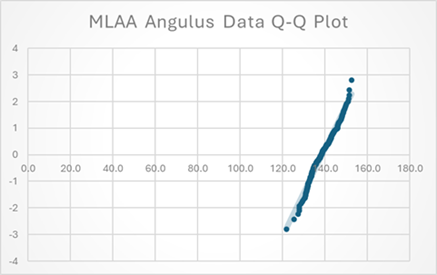
Shapiro–Wilk testing indicated statistically significant deviation from normality for RFA (goniometer: W = 0.964, p < 0.001; Angulus: W = 0.965, p < 0.001) and MLAA (goniometer: W = 0.984, p = 0.026; Angulus: W = 0.984, p = 0.025). However, visual inspection of Histograms and Q–Q plots (Fig. 1-4) demonstrated approximate normal distribution; therefore, parametric analyses were considered appropriate.
Figure 1. Q-Q plot for RFA goniometer measurements
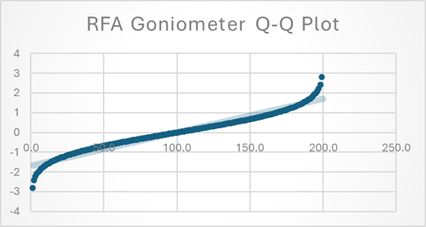
Figure 2. Q-Q plot for RFA Angulus measurements
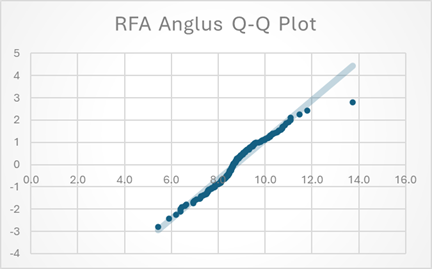
Figure 3. Q-Q plot for MLAA goniometer measurements
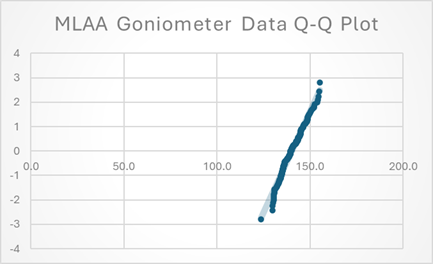
Figure 4. Q-Q plot for MLAA Angulus measurements
Assessor 1 recorded three measurements of RFA and Medial Longitudinal MLAA using both the universal goniometer and the Angulus application. The mean of the three trials was used for validity analysis.
3.1 Concurrent validity
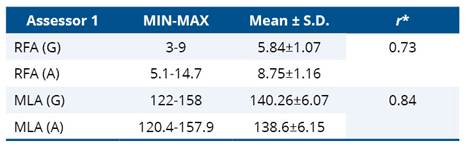
Concurrent validity of the Angulus application was evaluated by correlating its measurements with those obtained from the universal goniometer, as shown in table 2.
Table 2. RFA and MLAA values by goniometer and Angulus App performed by Assessor 1
*r - Karl Pearson correlation coefficient; S.D. - Standard deviation.
A strong positive correlation was observed between the two instruments for the RFA (r = 0.73) and MLAA (r = 0.84). These findings indicate good concurrent validity of the Angulus application for measuring foot posture angles.
3.2 Inter-Rater reliability of Angulus app
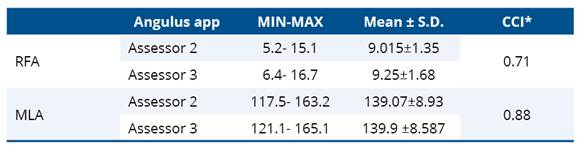
Inter-rater reliability was assessed using measurements obtained independently by Assessor 2 and Assessor 3 using the Angulus application, as presented in table 3.
Table 3. RFA and MLA Measurements using Angulus app by Assessor 2 and Assessor 3 for inter-rater reliability OR Inter-rater reliability of the Angulus app
*ICC - Intra class correlation coefficient; S.D - Standard deviation.
The ICC results were 0.71 (good reliability) for RFA and 0.88 (good to excellent reliability) for MLAA.
3.3 Intra-rater reliability of Angulus app
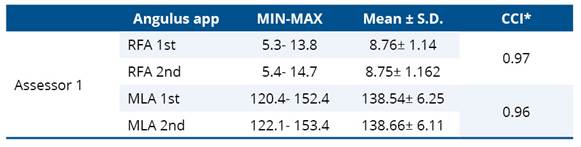
Intra-rater reliability for Assessor 1 was calculated using repeated Angulus measurements, as detailed in table 4. ICC values indicated excellent intra-rater reliability for RFA (ICC = 0.97) and MLAA (ICC = 0.96).
Table 4. RFA and MLAA Measurements using the Angulus app by Assessor 1 for intra-rater reliability of the Angulus app
*ICC - Intra class correlation coefficient; S.D. - Standard deviation.
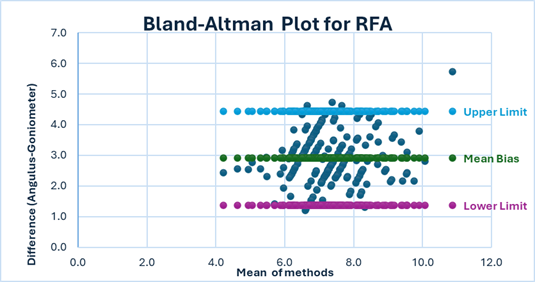
A Bland–Altman analysis was performed to assess agreement between the universal goniometer and the Angulus application. For RFA, the mean bias was 2.90°, with 95% limits of agreement ranging from 1.37° to 4.44° (Figure 5).
Figure 5. Bland-Altman Plot for RFA
For MLAA, the mean bias was −1.65°, with 95% limits of agreement from −8.19° to 4.90° (Figure 6).
Figure 6. Bland-Altman Plot for MLAA
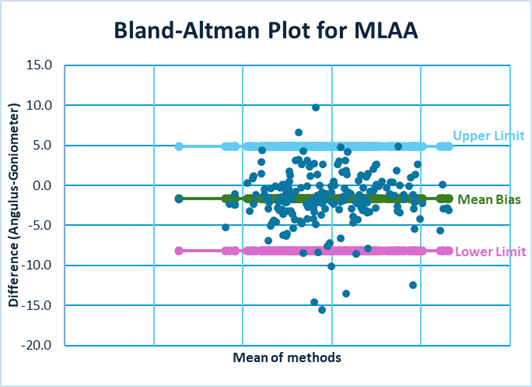
Visual inspection of the plots demonstrated acceptable agreement between the two measurement methods.
4. Discussion
The study aimed to establish the concurrent validity of the Angulus application and the universal goniometer and also determine its inter- and intra-rater reliability for measuring the RFA and the MLAA in healthy young individuals. The findings of the statistical analysis show good to strong concurrent validity (r = 0.73 for RFA; r = 0.84 for MLAA) and good to excellent reliability (inter-rater ICC = 0.71–0.88; intra-rater ICC = 0.96–0.97).
The Bland–Altman analysis showed a mean bias of 2.90° for RFA and −1.65° for MLAA, indicating that the Angulus app recorded slightly higher values than the goniometer for RFA and a slight tendency to record lower values with the Angulus app than with the goniometer for MLAA. The agreement limit was set to 95% (1.37° to 4.44°), which is relatively narrow, suggesting acceptable agreement between the two measurement methods. These results further support the concurrent validity of the Angulus application for assessing foot posture, indicating that the Angulus application yields measurements comparable and consistent with those obtained using a universal goniometer in healthy young individuals.
These findings can be supported by previous validation studies of smartphone-based goniometric applications. Porkodi et al. studied the reliability of Angulus for wrist flexion and extension in healthy individuals and reported exceptionally high Pearson correlation coefficients (r > 0.9) and ICCs exceeding 0.9. This study demonstrated excellent intra-rater reliability (0.96). However, our study found only moderate concurrent validity for the RFA (r = 0.73), compared to the very strong relationship (r > 0.9) observed in wrist measurements. This difference is likely attributable to the greater anatomical complexity of the rearfoot, and the challenges associated with palpating small bony landmarks, such as the calcaneus, compared with the more accessible landmarks of the wrist10.
Mitchell et al., in agreement with our study, found that photography-based apps are superior because the assessor receives a record of measurements and visualization of landmarks is easy using the photography method. However, our study included novice and experienced assessors, which helps us conclude that the Angulus interface is more user-friendly, even for entry-level assessors11. Ferriero et al. further reinforce the advantages of photo-based applications over traditional methods. Their study validated the "DrGoniometer" app for knee angle measurements, reporting inter-rater and intra-rater correlations exceeding 0.958, demonstrating that smartphone-integrated cameras effectively overcome these barriers. By providing computer-like functionality within a single device (viz., a mobile phone), applications such as Angulus and DrGoniometer streamline the measurement process without compromising the integrity of the diagnosis12.
Accurate landmark identification and standardized camera positioning are critical for reliable assessment of foot posture, which may have affected the variations seen in our study while measuring RFA. The reliability values obtained in this study suggest that, when standardized procedures are implemented, smartphone photogrammetry can provide stable measurements of both RFA and MLAA in healthy populations.
The inter-rater reliability of the Angulus application ranged from good to excellent. The slightly lower inter-rater ICC for RFA compared to MLAA may reflect greater technical difficulty in consistently identifying posterior calcaneal landmarks across different examiners. In contrast, the excellent intra-rater reliability indicates that repeated measurements by the same examiner using Angulus are highly stable, which is clinically encouraging for longitudinal patient monitoring.
The automated angle calculation feature of the Angulus application likely reduces arithmetic and reading errors commonly associated with manual goniometry. This may partly explain the high intra-rater consistency observed. These factors may have contributed to the slight measurement bias observed in the Bland–Altman analysis and minor variability in inter-rater reliability in the present study. However, potential sources of measurement error remain, such as improper smartphone positioning during image capture, variation in camera-to-subject distance, inaccuracies in landmark marking, and variability in image resolution. Careful palpation and pre-marking of anatomical landmarks may help minimize these errors.
Further methodological standardization is needed regarding optimal camera distance, height, angle of view, and minimum image resolution to enhance clinical usability. Developing clearer photogrammetric guidelines may improve between-examiner consistency and expand clinical applicability.
5. Study limitations
Several limitations must be considered when interpreting the findings of this study. The sample consisted exclusively of healthy young individuals, which may limit generalizability when assessing patients with altered foot biomechanics caused by deformities, pain, edema, etc. The absence of pathological variability may have contributed to higher reliability estimates, driven by sample restriction bias.
Although normality was assessed and appropriate parametric statistics were applied, correlation analysis alone does not confirm full agreement between methods. During the Bland–Altman analysis, residual proportional bias cannot be entirely excluded. Furthermore, the cross-sectional design limits conclusions regarding responsiveness or sensitivity to change over time, which are important for longitudinal clinical monitoring.
Despite these limitations, the findings support the Angulus application as a practical and cost-effective alternative to the universal goniometer for measuring RFA and MLAA in healthy individuals when standardized protocols are implemented. The photographic record feature may also offer additional benefits for clinical documentation and tele-rehabilitation.
6. Conclusion
The results demonstrated a strong correlation with universal goniometry and good-to-excellent intra- and inter-rater reliability. The Angulus application may serve as a useful tool for clinical measurement of RFA and MLAA, serving as an alternative to the universal goniometer in physiotherapy practice.
Ethical consideration
The Institutional Review Board (IRB) of Sardar Bhagwan Singh University reviewed the research proposal submitted following the prescribed guidelines of The Indian Council of Medical Research (ICMR). The IRB unanimously approved the proposal, ensuring the rights, safety, and well-being of the participants. IRB No. SBSU/PhD/2021/PT-IRB/202
Authors’ contributions
The authors declared that they have made substantial contributions to the work in terms of the conception or design of the research; the acquisition, analysis or interpretation of data for the work; and the writing or critical review for relevant intellectual content. All authors approved the final version to be published and agreed to take public responsibility for all aspects of the study.
Competing interests
No financial, legal, or political conflicts involving third parties (government, private companies, and foundations, etc.) were declared for any aspect of the submitted work (including but not limited to grants and funding, advisory board participation, study design, manuscript preparation, statistical analysis, etc.).
Indexers
The Journal of Physiotherapy Research is indexed by DOAJ, EBSCO, LILACS and Scopus.
References
1. Mendonça LM, Bittencourt NFN, Amaral GM, Diniz LS, Souza TR, Fonseca ST. A quick and reliable procedure for assessing foot alignment in athletes. J Am Podiatr Med Assoc. 2013;103(5):405-10. https://doi.org/10.7547/1030405
2. Dahle LK, Mueller MJ, Delitto A, Diamond JE. Visual assessment of foot type and relationship of foot type to lower extremity injury. J Orthop Sports Phys Ther. 1991;14(2):70-4. https://www.jospt.org/doi/10.2519/jospt.1991.14.2.70
3. McPoil TG, Cornwall MW. Prediction of dynamic foot posture during running using the longitudinal arch angle. J Am Podiatr Med Assoc. 2007;97(2):102-7. https://doi.org/10.7547/0970102
4. McPoil TG, Cornwall MW. Relationship between three static angles of the rearfoot and the pattern of rearfoot motion during walking. J Orthop Sports Phys Ther. 1996;23(6):370-5. https://www.jospt.org/doi/10.2519/jospt.1996.23.6.370
5. Wang KY, Hussaini SH, Teasdall RD, Gwam CU, Scott AT. Smartphone applications for assessing ankle range of motion in clinical practice. Foot Ankle Orthop. 2019;4(3):2473011419874779. https://doi.org/10.1177/2473011419874779
6. Muralidaran S, Wilson-Smith AR, Maharaj M, Beshara P, Nettleton L, Wang T, et al. Validation of a Novel Digital Goniometer as a Range of Motion Assessment Tool for The Lower Extremity. J Orthop Res Ther [Internet]. 2020;5:1158. Available from: https://pdfs.semanticscholar.org/20ba/4b1da4feca60bf908c4c673142526d9a23a0.pdf
7. Jones A, Sealey R, Crowe M, Gordon S. Concurrent validity and reliability of the Simple Goniometer iPhone app compared with the Universal Goniometer. Physiother Theory Pract. 2014;30(7):512-6. https://doi.org/10.3109/09593985.2014.900835
8. Özçelep ÖF, Yavuzer MG, Tunali AN. The validity and reliability of a smartphone application for measuring wrist and metacarpophalangeal joint motion. Cureus. 2024;16(4):e58047. https://doi.org/10.7759/cureus.58047
9. Yonaga LLC. Angulus: Digital goniometer application [Internet]. Yonaga; 2025. Available from: https://yonaga.app/angulus
10. Porkodi J, Karthik V, Mathunny JJ, Ashokkumar D. Reliability and Validity of Angulus- Smartphone Application for Measuring Wrist Flexion and Extension. In: Proceedings of the 3rd International conference on Artificial Intelligence and Signal Processing (AISP). Vijayawada: IEEE; 2023. p. 1-4. https://doi.org/10.1109/AISP57993.2023.10135006
11. Mitchell K, Gutierrez SB, Sutton S, Morton S, Morgenthaler A. Reliability and validity of goniometric iPhone applications for the assessment of active shoulder external rotation. Physiother Theory Pract. 2014;30(7):521-5. https://doi.org/10.3109/09593985.2014.900593
12. Ferriero G, Vercelli S, Sartorio F, Foti C. Accelerometer-and photographic-based smartphone applications for measuring joint angle: are they reliable? J Arthroplasty. 2014;29(2):448-9. https://doi.org/10.1016/j.arth.2013.06.014
