Original article
Prevalence and obstacles to return to work three months after ICU discharge / Prevalência e obstáculos ao retorno ao trabalho três meses após alta da UTI
Vanessa Marcela Lima dos Santos1 (https://orcid.org/0009-0003-8743-9517)
Kátia Santana Freitas2 (https://orcid.org/0000-0002-0491-6759)
Aloísio Machado da Silva Filho3 (https://orcid.org/0000-0001-8250-1527)
Monneglesia Santana Lopes Cardoso4 (https://orcid.org/0000-0001-9548-616X)
Pollyana Pereira Portela5 (https://orcid.org/0000-0002-6840-4533)
Vivian Manuela Lima dos Santos6 (https://orcid.org/0000-0001-8645-4094)
1Corresponding contact. Universidade Estadual de Feira de Santana (Feira de Santana). Bahia, Brazil. [email protected]
2-6Universidade Estadual de Feira de Santana (Feira de Santana). Bahia, Brazil.
ABSTRACT | OBJECTIVES: To estimate the prevalence of return to work three months after discharge from the intensive care unit (ICU) and characterize barriers associated with this return. METHODS: This cross-sectional study, nested within a prospective cohort, was conducted between 2022 and 2023 at a large public hospital in the countryside of Bahia, Brazil, including adults assessed three months after ICU discharge. Sociodemographic and clinical data were collected, along with the Obstacles to Return to Work Questionnaire (ORTWQ). Statistical analyses were performed using SPSS and R, including descriptive and inferential analyses. RESULTS: Among the 52 participants, most were male (76.9%), identified as Black or mixed-race (96.0%), had medical admissions (52.1%), and were classified as critically ill (65%). The prevalence of return to work three months after ICU discharge was 19.2%. Among those who remained away from work, 43.9% reported health-related reasons. The main perceived barriers were increased pain and the need for rest, whereas positive interpersonal relationships and positive self-perception were identified as favorable aspects. CONCLUSION: Three months after ICU discharge, the prevalence of return to work was low. ICU survivors face challenges primarily in the physical domain but benefit from favorable social, family, and occupational support.
KEYWORDS: Intensive Care Units. Critical Care. Return to Work. Occupational Health.
RESUMO | OBJETIVOS: Estimar a prevalência de retorno ao trabalho três meses após a alta da unidade de terapia intensiva (UTI) e caracterizar os obstáculos relacionados a esse retorno. MÉTODO: Estudo transversal aninhado a uma coorte prospectiva, conduzido entre 2022 e 2023, em hospital público de grande porte no interior baiano, com adultos três meses após a alta da UTI. Utilizaram-se as informações sociodemográficas e clínicas, bem como o instrumento Obstacles to Return to Work Questionnaire (ORTWQ). Análise realizada pelo SPSS e R, com estatística descritiva e analítica. RESULTADOS: Dos 52 participantes, a maioria era do sexo masculino (76,9%), cor de pele preta e parda (96,0%), internamento de natureza clínica (52,1%), classificados como graves (65%). A prevalência de retorno ao trabalho três meses após a alta da UTI foi de 19,2% e, entre os que ainda se encontravam afastados do trabalho, 43,9% por motivos de saúde. Os principais obstáculos percebidos foram o aumento da dor e a necessidade de descanso; as boas relações interpessoais e a autopercepção positiva foram aspectos satisfatórios. CONCLUSÃO: Três meses após a alta da UTI, a prevalência de retorno ao trabalho foi baixa. Egressos da UTI enfrentam desafios no domínio físico, mas contam com suporte social, familiar e ocupacional favorável.
PALAVRAS-CHAVE: Unidades de Terapia Intensiva. Cuidados Críticos. Retorno ao Trabalho. Saúde Ocupacional.
How to cite this article: Santos VML, Freitas KS, Silva Filho AM, Cardoso MSL, Portela PP, Santos VML. Prevalence and obstacles to return to work three months after ICU discharge. J Contemp Nurs. 2026;15:e6743. https://doi.org/10.17267/2317-3378rec.2026.e6743
Submitted Feb. 8, 2026, Accepted May 18, 2026, Published July 24, 2026
J. Contemp. Nurs., Salvador, 2026;15:e6743
https://doi.org/10.17267/2317-3378rec.2026.e6743
ISSN: 2317-3378
Assigned editors: Cátia Palmeira, Tássia Macêdo
1. Introduction
Advances in intensive care have substantially increased the survival of individuals experiencing critical illness, making the intensive care unit (ICU) a central setting for treatment and recovery. However, ensuring survival alone does not fulfill the role of intensive care. The effects of hospitalization in a high-complexity environment extend beyond hospital discharge, imposing functional, psychological, and social challenges that may persist in the long term and increasingly demand scientific and clinical attention1-3.
The abrupt disruption to daily life caused by ICU hospitalization may function both as an immediate environmental stressor and as a risk factor for reduced short- and long-term well-being4. Surviving critical illness is essential; however, the full restoration of biological and psychological functions as well as reintegration into social life for all individuals involved in the illness experience, including return to work, is equally important. Ensuring quality of life following severe illness remains one of the major contemporary health care challenges2.
The cluster of impairments that emerge or worsen after ICU discharge has been systematized under the umbrella term post-intensive care syndrome (PICS), which encompasses physical, cognitive, mental, and social impairments that may persist for months or years after hospital discharge2,3. Although return to work has increasingly been recognized as a relevant recovery outcome after ICU discharge, bibliometric analyses of the PICS literature indicate that scientific production remains concentrated on cognitive, mental, and physical domains, whereas social role performance, including employment, continues to be underrepresented as a focus of systematic investigation5.
Systematic reviews confirm that unemployment is a frequent consequence following ICU admission6-8, yet despite evidence supporting the importance of return to work, this outcome requires greater attention in interventional critical care research9-11. This knowledge gap is relevant for both scientific advancement and clinical practice, as the ability to work represents a central dimension of functional recovery and social autonomy4,12,13.
Work plays a fundamental role in an individual’s life as a source of identity, income, social belonging, and quality of life7. The inability to resume occupational activities following critical illness cannot be considered a secondary outcome, as it further reflects incomplete recovery. Estimates indicate that approximately two-thirds of individuals remain away from work three months after ICU admission6,14, and a multicenter cohort study conducted in Brazil found that 61.1% of workers had not returned to work within the same period15.
Individuals who successfully return to work after ICU hospitalization often do so under unfavorable conditions, including occupational status deterioration or job loss in the short term14. Post-ICU unemployment affects household income, social cohesion, and collective well-being, disproportionately impacting informal workers and socioeconomically vulnerable populations7. Consequently, the absence of structured post-ICU rehabilitation programs shifts the burden of care to families and eventually returns to the health care system through avoidable costs associated with readmissions and long-term dependency. Within the context of the Brazilian Unified Health System (SUS), where resource limitations and structural vulnerabilities remain important concerns, this gap in continuity of care assumes significant relevance and requires careful scientific and policy attention6,7,16.
From a societal perspective, work represents a valuable component for individuals and families in their particular contexts, as well as for society as a whole4. Demonstrating how critical illness affects the social dimension and particularly employment, broadens understanding of the illness experience beyond the hospital setting and strengthens public health perspectives. Studies have shown that return to work after critical illness improves quality of life and psychosocial outcomes6,18, whereas prolonged work absence negatively affects family income and physical and mental health10.
Within this context, nursing plays a central and irreplaceable role. Nursing professionals maintain continuous contact with ICU patients, monitor clinical progression throughout hospitalization, identify early signs of functional impairment, and establish initial connections with families19. Recognizing barriers to return to work, including physical, psychosocial, and workplace-related factors, is part of the comprehensive care that nursing should provide not only during hospitalization but also through follow-up and transitional care programs12 as well as rehabilitation and social reintegration initiatives. Scientific production in nursing within this field is therefore essential to support protocols, improve post-discharge care, and influence long-term care policies for ICU survivors19,20.
Because of the social relevance of employment as a recovery outcome and the need to expand nursing knowledge regarding the long-term consequences of intensive care, this study aimed to estimate the prevalence of return to work three months after ICU discharge and characterize barriers associated with this return.
2. Methods
This was a cross-sectional study with a quantitative approach, conducted between January 2022 and February 2023 at a large public general hospital located in the countryside of the state of Bahia, Brazil. Data were derived from a patient follow-up cohort, with a temporal assessment point at three months after ICU discharge. This study was reported following the Strengthening the Reporting of Observational Studies in Epidemiology (STROBE) guidelines21.
The study included individuals discharged from ICU who met the following eligibility criteria: age ≥ 18 years, ICU stay of at least 48 hours, being alert and oriented during data collection, absence of prior cognitive or psychiatric disorders, and no use of medications for mental health conditions such as anxiety or depression. Participants transferred from ICUs at other hospitals, those discharged directly home, individuals under contact or respiratory isolation precautions, those with preexisting physical or cognitive disabilities, and individuals for whom telephone contact was not possible were excluded. Patients discharged directly home were excluded because this condition precluded baseline data collection in the hospital inpatient unit.
Data collection began with daily screening of the hospital information system among patients scheduled for discharge, enabling identification and selection of eligible participants. Sociodemographic, clinical, and social work-related information was obtained during hospitalization from electronic medical records and supplemented through structured interviews conducted using a multi-topic questionnaire. Before inpatient interviews, all participants received information regarding study objectives and signed an informed consent form.
Participants were contacted at two distinct time points. At baseline, face-to-face interviews were conducted in inpatient wards, lasting approximately 25 minutes, within 5 days after ICU discharge, while ensuring privacy conditions. Clinical data were obtained from electronic medical records; variations in sample size across variables resulted from missing data. Follow-up occurred three months after ICU discharge through telephone interviews lasting approximately 16 minutes, with participants instructed to remain in a private setting during data collection.
Both interviews were conducted by nurse researchers and undergraduate research scholarship students previously trained according to the Data Collection Manual (ISBN 978-65-01-76027-8). A structured protocol was followed, with real-time completion of study instruments. Procedures were refined during a 3-month pilot study.
Data collection supervision and auditing were conducted throughout the study under the responsibility of nurse researchers. Collected data were anonymized, stored in the Research Electronic Data Capture (REDCap) platform, and accessed exclusively by authorized investigators for scientific purposes. To minimize bias, multiple telephone contact attempts at different days and times were implemented to reduce attrition bias, and independent double data entry into REDCap with periodic consistency audits was performed to reduce measurement bias.
Participants were selected through nonprobability sampling. Initially, consecutive sampling was used, whereby all eligible patients during the study period were invited to participate. Eligible individuals were approached during hospitalization in inpatient wards, resulting in an initial cohort of 212 participants. Of these, only participants successfully followed for three months after ICU discharge were included, totaling 77 individuals. Considering only participants employed before ICU admission, 52 were eligible for analysis (Figure 1).
Figure 1. Flowchart of participant selection for the study, Feira de Santana, Bahia, Brazil, 2022-2023
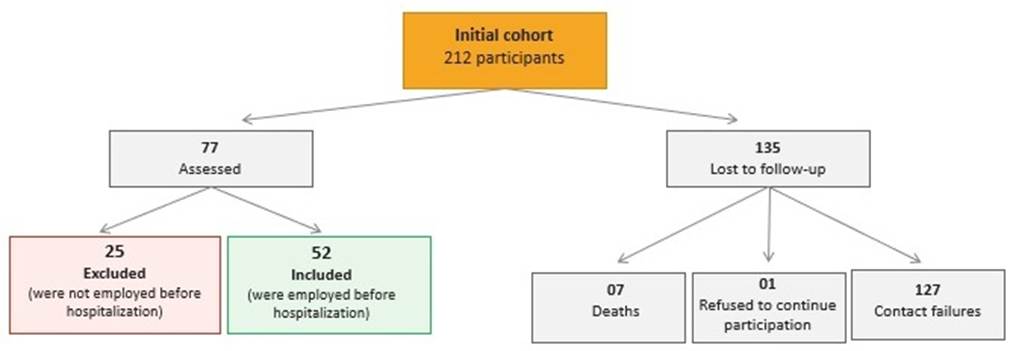
Among the 212 participants in the initial cohort, 135 (63.7%) were lost during the 3-month follow-up period: seven (3.3%) due to post-discharge death, one (0.5%) due to refusal, and 127 (59.9%) due to unsuccessful telephone contact. Follow-up losses are widely reported in ICU survivor studies, with retention rates ranging from 18% to 100% depending on follow-up duration, clinical severity, and available support infrastructure22, potentially introducing selection bias23. The follow-up retention observed in this study is consistent with investigations conducted in resource-limited settings, as demonstrated by previous studies in public hospital contexts22,24.
Occupational status was assessed using the Social Work Characteristics Questionnaire, which investigates income, employment status before and after hospitalization, workload, and perceived work capacity. Barriers to return to work were assessed using the Obstacles to Return to Work Questionnaire (ORTWQ), a multidimensional instrument validated for the Brazilian context25, comprising 55 items distributed across nine domains. For this study, 27 items from four domains were strategically selected: i) difficulties returning to work (DRW, 8 items), ii) social support at work (SSW, 6 items), iii) family support and situation (FSS, 7 items), and iv) self-perceived prognosis for return to work (SPRW, 6 items).
Partial domain selection prioritized the study objective and characteristics of the target population. This decision did not compromise interpretation because the Brazilian adaptation recommends domain-specific assessment without a total score, preserving psychometric properties of each subscale independently of omitted items. Negatively worded items were reverse-scored (0=6, 1=5, 2=4, 3=3, 4=2, 5=1, 6=0): items 5, 18, and 31 (SSW); items 9, 27, and 32 (FSS); and items 1, 3, 4, 5, and 6 (SPRW). Higher scores indicate greater barriers to returning to work25.
ORTWQ was applied exclusively to the 42 participants employed before hospitalization who had not returned to work after ICU discharge. Of these, 23 completed the instrument (response rate: 54.8%; losses: 45.2%), partly attributed to the 7-point Likert scale (0-6), which proved difficult to understand, resulting in refusals and inability to complete responses. Among respondents, the number of valid participants per item ranged from 16 to 23, with the lowest response frequency observed for the item regarding supervisors’ understanding of worker pain (n = 16), which was not applicable to self-employed participants without supervisory structures.
Data analysis was performed using IBM SPSS Statistics for Windows, version 22.0 (IBM Corp., Armonk, N.Y., USA) and R version 4.5.0. Categorical variables were described using absolute and relative frequencies. Continuous variables, after confirmation of non-normal distribution using the Shapiro-Wilk test, were described as median and interquartile range (IQR). Group comparisons (returned to work versus did not return to work) were conducted using the Mann-Whitney U test for continuous variables and Fisher’s exact test for categorical variables (α = 0.05). Multicategory variables underwent global testing followed by pairwise comparisons. ORTWQ domain items were described using median and IQR.
The study was approved by the Human Research Ethics Committee of the State University of Feira de Santana (Universidade Estadual de Feira de Santana - UEFS) under approval number 3.527.238 (CAAE: 13234419.9.0000.0053) and conducted in accordance with Conselho Nacional de Saúde Resolutions No. 466/2012, No. 510/2016, and No. 580/2018, Good Clinical Practice guidelines, and the Brazilian General Data Protection Law (Lei n° 13.709/2018).
3. Results
Among the 52 eligible participants who had been employed before hospitalization, the median age was 49.0 years (IQR 38.0-61.0). Most participants were male (76.9%), identified as Black or mixed-race (96.0%), had higher educational attainment (67.3%), had no partner (53.8%), reported having a religious affiliation (90.4%), had a household income of up to 3 minimum wages (89.6%), were admitted for medical conditions (52.1%), and were classified as critically ill (65%), as shown in Table 1.
At the end of the 3rd month after ICU discharge, only 19.2% had returned to work. Return-to-work rates were higher among male participants (22.5%), Black and mixed-race participants (20.8%), those with higher educational attainment (25.7%), and participants with a household income above four minimum wages (40.0%). Regarding previous health status, most participants had no prior physical health conditions or previous ICU admissions. The median hospital length of stay was 9 days (IQR 6-15), and the median ICU stay was 5 days (IQR 3-10). The sample was evenly distributed between medical (52%) and surgical (48%) diagnoses, with similar return-to-work rates across groups (20.0% and 21.7%, respectively). Among participants classified as critically ill, 15.4% returned to work.
Table 1. Sociodemographic and clinical characteristics of patients according to return to work three months after discharge from intensive care unit, Feira de Santana, Bahia, Brazil, 2022-2023 (n = 52)
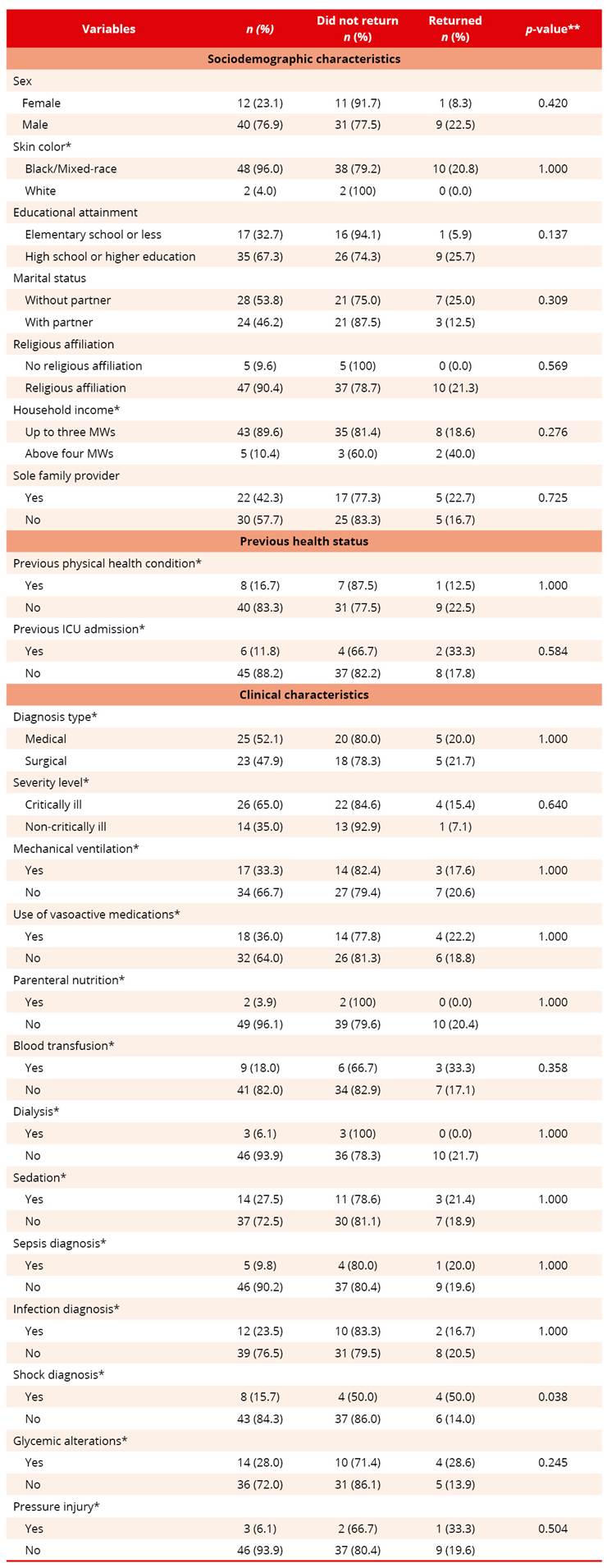
Note. MW = minimum wage. n (%): absolute and relative frequencies calculated based on the total number of participants within each category (row total). *n < 52 indicates missing data. **Comparisons were performed using Fisher’s exact test; p < 0.05 was considered statistically significant. The first category of each variable represents the comparison group, whereas the second category represents the reference group. Clinical severity level was classified according to the Brazilian Consensus on Hemodynamic Monitoring and Support26.
Table 1 also shows that most participants did not undergo invasive therapeutic interventions and did not experience the evaluated clinical complications. Return-to-work rates were similar across subgroups, ranging from 14% to 22%, regardless of exposure to supportive interventions or occurrence of complications. The only exception was shock of any type, which was absent in 84.3% of participants and showed a return-to-work rate of 14% within this subgroup, representing the only clinical variable significantly associated with return to work (p = 0.038).
Regarding work status characteristics, presented in Table 2, all 52 participants were employed before hospitalization. At three months after ICU discharge, 19.2% had returned to work, whereas 80.8% remained away from occupational activities. Among participants who reported their employment status at the time of assessment, most were on medical leave (43.9%), followed by unemployment (24.4%). Among unemployed individuals and those on medical leave, most respondents believed that work absence affected their quality of life and was related to their health condition (88.9%).
Table 2. Work status characteristics of patients three months after discharge from intensive care unit, Feira de Santana, Bahia, Brazil, 2022-2023 (n = 42)
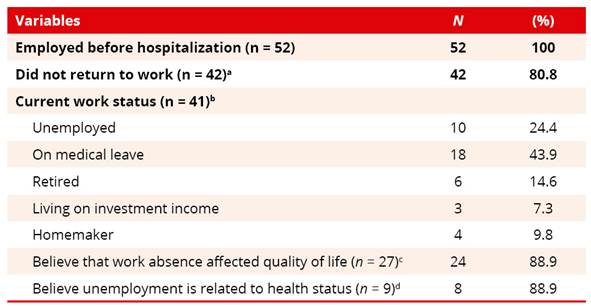
Note. aA total of 10 participants returned to work (10/52 = 19.2%). bOne participant did not answer the question regarding current work status (n = 41). cSubgroup composed of unemployed participants and those on medical leave (n = 28), of whom one did not respond (n = 27). dSubgroup of unemployed participants (n = 10), of whom one did not respond (n = 9).
Barriers to return to work were investigated in 42 participants who remained away from work at the 3rd month after ICU discharge. However, the number of respondents varied across ORTWQ items (16 to 23 participants) due to partial missing data. Table 3 presents barriers according to domain.
Within the DRW domain, participants demonstrated a high perception of barriers. Median scores ranged from 3.0 to 5.5 across most items, particularly regarding pain-related functional limitations, need for rest, and social isolation. Items related to the impact of fatigue on life meaning showed lower median values (2.0-3.5), with wide interquartile variability.
Within the SSW domain, median scores were predominantly zero or close to zero, indicating low perceived workplace barriers. Items related to supervisor relationships demonstrated greater variability (median 0.0-1.5; wide IQR), suggesting that managerial support represented a more substantial barrier for some participants.
Within the FSS domain, nearly all items presented median scores of zero and narrow IQRs, demonstrating a more homogeneous pattern than the other domains. The exception was the item regarding difficulty finding energy to work because of family or social problems (IQR 0.00-4.00), which showed greater variability within the domain, suggesting that this factor exerted a more substantial impact on a subset of respondents.
Table 3. Barriers related to return to work three months after discharge from intensive care unit, Feira de Santana, Bahia, Brazil, 2022-2023 (n = 42)
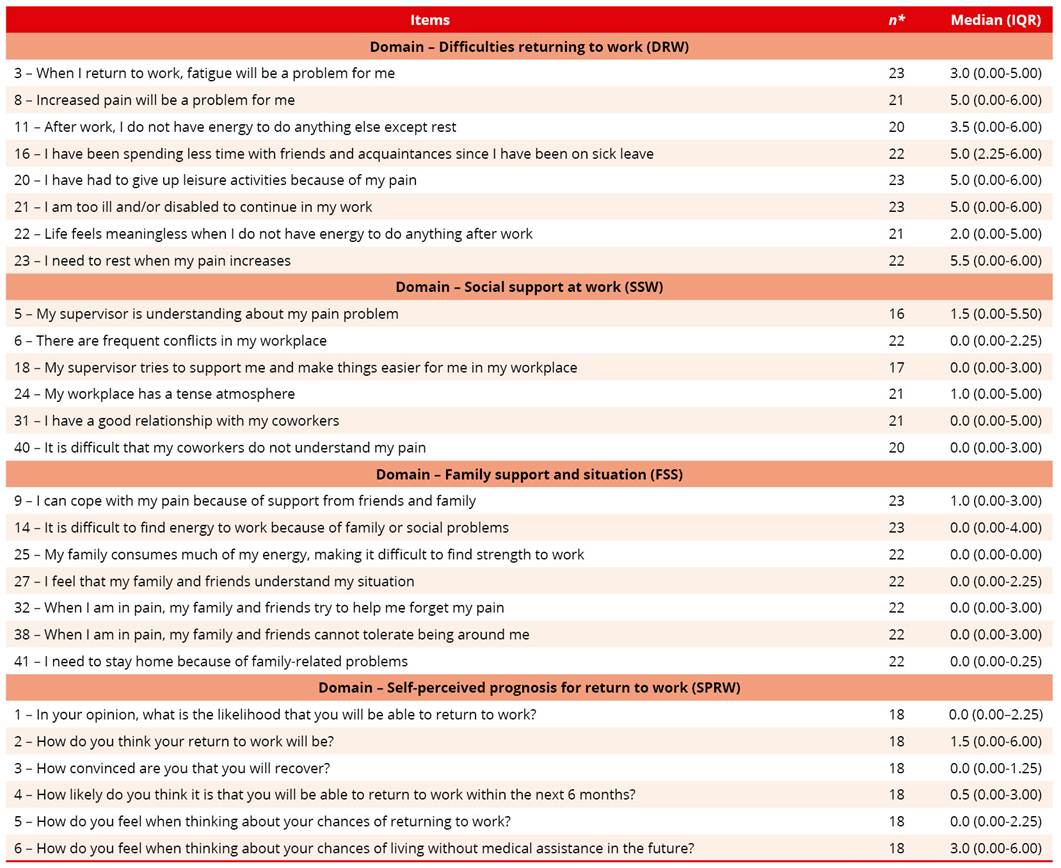
Note. IQR = interquartile range. *n = total number of participants differs across items because of missing responses. Item scores range from 0 to 6. The lower number of respondents for item 5 in the SSW domain reflects item non-applicability to self-employed participants. Non-normal distribution was confirmed using the Shapiro-Wilk test.
Within the SPRW domain, beliefs regarding the possibility of returning to work were predominantly favorable. Items assessing perceived likelihood of return and motivation presented median scores of zero or close to zero after reverse scoring, suggesting absence of perceived barriers for most participants in this domain. Greater uncertainty was observed for items related to perceived difficulty in the return-to-work process (median 1.5) and future independence from medical care (median 3.0), both showing wide interquartile dispersion.
4. Discussion
The sample consisted predominantly of male adults, self-identified as Black or mixed-race, with low educational attainment and a monthly income ranging from 1 to 3 minimum wages, a profile consistent with previous investigations involving ICU survivors11,15. Prior research indicates that lower educational attainment is a predictor of delayed return to work6,7,15, whereas more years of education are associated with a lower likelihood of developing PICS27. In the current study, no statistically significant associations were identified between clinical characteristics and return to work. However, existing evidence suggests that disease severity at admission and complications occurring during hospitalization contribute to inability to return to work3,15.
The prevalence of return to work three months after ICU discharge in this study was 19.2%. A systematic review with meta-analysis including data from more than 20 cohort studies across different countries estimated that approximately one-third of ICU survivors return to work within the first three months after discharge, with substantial variation according to follow-up duration, disease severity, and institutional context6.
In settings with greater post-discharge support infrastructure and organized rehabilitation programs, such as those described in European cohorts, return-to-work rates tend to be higher, ranging from 30% to 50%9,28. This finding suggests that occupational outcomes after critical illness are not determined solely by clinical severity. Rather, availability of health care resources and the survivor’s socioeconomic context also appear to play substantial roles. Additionally, the high follow-up loss observed in this study may have introduced selection bias, and estimates should therefore be interpreted in light of this structural limitation23.
In Brazil, a multicenter cohort study found that 61.1% of ICU survivors had not returned to work three months after discharge15. Although this finding highlights the magnitude of the issue nationally, return-to-work rates in that study were proportionally higher than those observed in the present investigation. This difference may partially reflect characteristics of the study setting, a public hospital in the countryside of Bahia, Brazil, with a relatively small sample predominantly composed of workers with low educational attainment, household income below 3 minimum wages, and unstable employment conditions, characteristics that define a profile of marked socioeconomic vulnerability.
Among the 80.8% of participants who had not returned to work by the end of the 3rd month, employment situations were heterogeneous, with medical leave and unemployment being the most frequent conditions. Although medical leave interrupts work participation, it preserves formal employment and temporary income, whereas unemployment represents complete employment disruption, carrying more severe economic and psychosocial consequences29.
Employment outcomes have also been investigated in the United Kingdom, where a substantial proportion of ICU survivors became dependent on social benefits after discharge, representing a trajectory of prolonged economic dependence18. Another 12-month follow-up study documented substantial deterioration in occupational status among ICU survivors, accompanied by income reduction and worsening socioeconomic conditions10.
The finding that 88.9% of participants who were unemployed or on medical leave reported a negative impact of work absence on quality of life, and that an equivalent proportion attributed unemployment directly to their current health condition, is consistent with existing evidence. A systematic review with meta-analysis investigating associations between return to work and psychosocial outcomes demonstrated that employment after critical illness is associated with better mental health, stronger sense of identity, and improved perceived quality of life7.
Regarding barriers to return to work, the DRW domain showed the most prominent pattern among the four domains evaluated, particularly concerning increased pain and perceived inability to continue working. This barrier profile aligns with the manifestations commonly observed in PICS, which encompasses persistent physical, cognitive, psychological, and social impairments after ICU discharge1,3. An additional systematic review identified physical impairments, including pain, fatigue, and reduced functional capacity, among the most consistent predictors of inability to return to work after critical illness, regardless of setting or outcome definition8.
A prospective study following patients for 1 year after ICU discharge demonstrated that both physical and psychosocial factors influence return to work, with physical limitations exerting particularly strong effects during the first months after discharge11. Social isolation, also captured within the DRW domain, is consistent with evidence documenting social network withdrawal as an indirect consequence of PICS10,13. This phenomenon may create a cycle in which physical limitations intensify social isolation, which in turn compromises motivation and perceived ability to return to work.
In contrast to findings within the physical domain, the SSW and FSS domains demonstrated predominantly null median scores, indicating that interpersonal conflict, unfavorable organizational climate, and family burden were not perceived as relevant barriers by most participants. Positive workplace relationships and family support were generally perceived as satisfactory. Previous evidence identifies social support as a consistent facilitator of return to work after hospitalization7,11,14. Favorable psychosocial factors, including workplace and family support, have been associated with better occupational outcomes during the first year after ICU discharge.
The SPRW domain revealed a predominantly favorable pattern, with null or near-null median scores regarding perceived likelihood and motivation to return to work, indicating absence of major barriers in this dimension for most respondents. This finding contrasts with the low prevalence of actual return to work observed in the study and suggests that positive self-perception, despite recognized predictive value in the literature, is insufficient when structural barriers, such as employment instability, lack of workplace accommodation, and limitations in social security support, interfere between intention and actual return14.
The broad interquartile dispersion observed for items regarding perceived difficulty in the return-to-work process and future independence from medical care indicates internal heterogeneity within this domain, with substantial uncertainty among a subset of respondents. This finding carries direct practical implications, as health care team interventions aimed at promoting realistic expectations during care transitions may help reduce discrepancies between self-perceived prognosis and actual barriers to return12,19.
The absence of organized post-ICU rehabilitation programs within SUS represents a substantial gap in care delivery. A Brazilian multicenter cohort demonstrated that failure to return to work remained frequent even in referral centers with greater health care capacity15, which suggests that this challenge cannot be addressed solely through improvements in inpatient care quality but also requires continuity of care after discharge. A study investigating the influence of intensive care quality on return to work among survivors of acute respiratory distress syndrome identified ICU care quality as a determinant of long-term outcomes28, which reinforces the role of nursing not only in acute management but also in early rehabilitation planning and discharge preparation19.
Nursing professionals are continuous members of the ICU health care team and hold a central role in care transitions and occupy a strategic position in early identification of risk factors associated with failure to return to work, screening physical and nonphysical impairments during hospitalization, referral to rehabilitation services, and post-discharge follow-up19,20.
Key study limitations include the small sample size, absence of instrument validation for the investigated population, operational challenges related to telephone follow-up, and difficulties understanding ORTWQ items, which contributed to participant loss. Additionally, data collection may have imposed emotional burden because participants were asked to recall experiences related to critical illness and report financial vulnerabilities. The cross-sectional design precludes causal inference, and findings should not be generalized given the sample’s vulnerability profile and the substantial follow-up losses. Nevertheless, this study presents important strengths, including investigation of an emerging topic within the national scientific agenda and use of a multidimensional instrument to assess barriers to return to work.
5. Conclusion
ICU survivors demonstrated a low prevalence of return to work three months after discharge. Predominant barriers were physical in nature, particularly pain and need for rest. Social support domains (workplace and family) and return-to-work perceptions demonstrated favorable patterns for most participants, without major barriers. However, the broad variability observed in items related to perceived return difficulty and future independence suggests internal group heterogeneity, with substantial uncertainty among a subset of respondents.
These findings highlight the need for early and continuous nursing interventions beginning during ICU hospitalization, considering that physical, cognitive, psychological, and social sequelae compromising return to work, grouped under the concept of PICS, originate during the critical phase of illness. Furthermore, multicenter investigations with follow-up focused on occupational reintegration are recommended, as they are essential for understanding structural and individual barriers faced by this population and for supporting development of rehabilitation programs and interventions aimed at improving functionality and quality of life after ICU discharge.
Authors’ contributions
The authors declared substantial contributions to the study regarding study conception or design, data acquisition, analysis or interpretation, and drafting or critical revision of relevant intellectual content. All authors approved the final version for publication and agreed to assume public responsibility for all aspects of the study.
Competing interests
No financial, legal, or political conflicts of interest involving third parties (government agencies, companies, private foundations, or others) were declared regarding any aspect of the submitted work, including but not limited to grants and funding, advisory board participation, study design, manuscript preparation, statistical analysis, or related activities.
Indexers
The Journal of Contemporary Nursing is indexed by DOAJ and EBSCO.
References
1. Robinson CC, Rosa RG, Kochhann R, Schneider D, Sganzerla D, Dietrich C, et al. Quality of life after intensive care unit: a multicenter cohort study protocol for assessment of long-term outcomes among intensive care survivors in Brazil. Rev Bras Ter Intensiva. 2018;30(4):405-13. https://doi.org/10.5935/0103-507X.20180063
2. Rousseau AF, Prescott HC, Brett SJ, Weiss B, Azoulay E, Creteur J, et al. Long-term outcomes after critical illness: recent insights. Crit Care. 2021;25(1):108. https://doi.org/10.1186/s13054-021-03535-3
3. Yuan C, Timmins F, Thompson DR. Post-intensive care syndrome: a concept analysis. Int J Nurs Stud. 2021;114:103814. https://doi.org/10.1016/j.ijnurstu.2020.103814
4. Oliveira RO, Martins AS, Silveira APCM. Memory records: a study on cognitive aspects after ICU Stay. Ciênc Cogn [Internet]. 2021;26(1):40-50. Available from: http://cienciasecognicao.org/revista/index.php/cec/article/view/1655
5. Paul N, Weiss B. Post-intensive care syndrome after critical illness: an imperative for effective prevention. J Clin Med. 2022;11(20):5933. https://doi.org/10.3390/jcm11206203
6. Kamdar BB, Suri R, Suchyta MR, Digrande KF, Sherwood KD, Colantuoni E, et al. Return to work after critical illness: a systematic review and meta-analysis. Thorax. 2020;75(1):17-27. https://doi.org/10.1136/thoraxjnl-2019-213803
7. McPeake J, Mikkelsen ME, Quasim T, Hibbert E, Cannon P, Shaw M, et al. Return to employment after critical illness and its association with psychosocial outcomes. a systematic review and meta-analysis. Ann Am Thorac Soc. 2019;16(10):1304-11. https://doi.org/10.1513/AnnalsATS.201903-248OC
8. Su H, Dreesmann NJ, Hough CL, Bridges E, Thompson HJ. Factors associated with employment outcome after critical illness: systematic review, meta-analysis, and meta-regression. J Adv Nurs. 2021;77(2):653-63. https://doi.org/10.1111/jan.14631
9. Beumeler LFE, van Wieren A, Buter H, van Zutphen T, Navis GJ, Boerma EC. Long-term health-related quality of life, healthcare utilisation and back-to-work activities in intensive care unit survivors: prospective confirmatory study from the Frisian aftercare cohort. PLoS One. 2022;17(9):e0273348. https://doi.org/10.1371/journal.pone.0273348
10. Griffiths J, Hatch RA, Bishop J, Morgan K, Jenkinson C, Cuthbertson BH, et al. An exploration of social and economic outcome and associated health-related quality of life after critical illness in general intensive care unit survivors: a 12-month follow-up study. Crit Care. 2013;17(3):R100. https://doi.org/10.1186/cc12745
11. Austenå M, Rustøen T, Småstuen MC, Valsø Å, Sunde K, Tøien K. Return to work during first year after intensive care treatment and the impact of demographic, clinical and psychosocial factors. Intensive Crit Care Nurs. 2023;76:103384. https://doi.org/10.1016/j.iccn.2023.103384
12. Inoue S, Nakanishi N, Amaya F, Fujinami Y, Hatakeyama J, Hifumi T, et al. Post-intensive care syndrome: recent advances and future directions. Acute Med Surg. 2024;11(1):e929. https://doi.org/10.1002/ams2.929
13. Norman BC, Jackson JC, Graves JA, Girard TD, Pandharipande PP, Brummel NE, et al. Employment outcomes after critical illness: an analysis of the bringing to light the risk factors and incidence of neuropsychological dysfunction in ICU survivors cohort. Crit Care Med. 2016;44(11):2003-9. https://doi.org/10.1097/CCM.0000000000001849
14. Hodgson CL, Udy AA, Bailey M, Barrett J, Bellomo R, Bucknall T, et al. The impact of COVID-19 critical illness on new disability, functional outcomes and return to work at 6 months: a prospective cohort study. Crit Care. 2021;25(1):382. https://doi.org/10.1186/s13054-021-03794-0
15. Mattioni MF, Rodrigues MK, Hoepers A, Nunes DSL, Grumann AC, Ghizoni MS, et al. Return to work after discharge from the intensive care unit: a Brazilian multicenter cohort. Rev Bras Ter Intensiva. 2022;34(1):492-8. https://doi.org/10.5935/0103-507X.20220169-pt
16. Kang J, Jeong YJ, Hong J. The effect of postintensive care syndrome on the quality of life of intensive care unit survivors: a secondary analysis. Aust Crit Care. 2021;34(3):246-53. https://doi.org/10.1016/j.aucc.2020.08.006
17. Oliveira NR, Santos GM. Trabalho e sentido para a vida: contribuições da logoterapia para encontrar o sentido da vida no exercício da profissão. 2a. ed. Natal: Offset Editora; 2017.
18. Quasim T, Brown J, Kinsella J. Employment, social dependency and return to work after intensive care. J Intensive Care Soc. 2015;16(1):31-6. https://doi.org/10.1177/1751143714556238
19. Eaton TL, McPeake J, Rogan J, Johnson A, Boehm LM. Caring for survivors of critical illness: current practices and the role of the nurse in intensive care unit aftercare. Am J Crit Care. 2019;28(6):481-5. https://doi.org/10.4037/ajcc2019885
20. Gutenbrunner C, Stievano A, Stewart D, Catton H, Nugraha B. Role of nursing in rehabilitation. J Rehabil Med Clin Commun. 2021;4:1000061. https://doi.org/10.2340/20030711-1000061
21. von Elm E, Altman DG, Egger M, Pocock SJ, Gøtzsche PC, Vandenbroucke JP; STROBE Initiative. The Strengthening the Reporting of Observational Studies in Epidemiology (STROBE) statement: guidelines for reporting observational studies. J Clin Epidemiol. 2008;61(4):344-9. https://doi.org/10.1016/j.jclinepi.2007.11.008
22. Young DL, Al-Ani A, Lakhmalla M, Raman V, Fatima A, Friedman LA, et al. Participant retention in follow-up studies of intensive care unit survivors: a scoping review. Aust Crit Care. 2024;37(6):964-70. https://doi.org/10.1016/j.aucc.2024.02.002
23. Wilcox ME, Ely EW. Challenges in conducting long-term outcomes studies in critical care. Curr Opin Crit Care. 2019;25(5):473-88. https://doi.org/10.1097/MCC.0000000000000650
24. Duarte PAD, Costa JB, Duarte ST, Taba S, Lordani CRF, Osaku EF, et al. Characteristics and outcomes of intensive care unit survivors: experience of a multidisciplinary outpatient clinic in a teaching hospital. Clinics. 2017;72(12):764-72. https://doi.org/10.6061/clinics/2017(12)08
25. Milani D, Souza AC, Hirayama MS, Alexandre NMC. Obstacles to return to work: Translation and cross-cultural adaptation of the questionnaire to the Brazilian context. Cien Saude Colet. 2018;23(5):1387-401. https://doi.org/10.1590/1413-81232018235.17152016
26. Rezende E, Réa-Neto A, David CM, Mendes CL, Dias FS, Schettino G, et al. Brazilian consensus on monitoring and hemodynamic support - Part I: method and definitions. Rev Bras Ter Intensiva [Internet]. 2005;17(4):278-81. Available from: https://www.amib.org.br/wp-content/uploads/2021/07/ConsensoMonitorizacaoSuporteHemodinamico.pdf
27. Marra A, Pandharipande PP, Girard TD, Patel MB, Hughes CG, Jackson JC, et al. Co-occurrence of post-intensive care syndrome problems among 406 survivors of critical illness. Crit Care Med. 2018;46(9):1393-401. https://doi.org/10.1097/ccm.0000000000003218
28. Apfelbacher C, Brandstetter S, Blecha S, Dodoo-Schittko F, Brandl M, Karagiannidis C, et al. Influence of quality of intensive care on quality of life/return to work in survivors of the acute respiratory distress syndrome: prospective observational patient cohort study (DACAPO). BMC Public Health. 2020;20(1):861. https://doi.org/10.1186/s12889-020-08943-8
29. Hauschildt KE, Seigworth C, Kamphuis LA, Hough CL, Moss M, McPeake JM, et al. Financial toxicity after acute respiratory distress syndrome: a national qualitative cohort study. Crit Care Med. 2020;48(8):1103-10. https://doi.org/10.1097/CCM.0000000000004378
